Ahead of her AutomationSTAR keynote, Quality Engineering Has an Identity Crisis… and AI Just Walked Into the Room, Laveena Ramchandani explores five skills that will matter more as AI takes on more of the mechanical work of testing.
Ask ten companies what Quality Engineering means today and you’ll get ten different answers – and at least three job titles nobody can properly explain.
That’s not a new problem. Manual testing became automation. Automation became Agile. Agile became DevOps. Each time, the job title changed and the core question stayed the same: what exactly are we here to do?
AI has just made that question urgent again. It can generate hundreds of test cases in seconds and produce dashboards that look impressively complete. What it can’t do is imagine a frustrated customer at midnight, trusting a product that quietly fails them at exactly the wrong moment. That gap between “the dashboard is green” and “the product is actually trustworthy” is where the next generation of QE skills live.
Here are five worth building now.
1. Judgment over green ticks
A passing test suite has never meant the same thing as a working product, but AI-generated coverage makes that gap easier to hide. When hundreds of test cases can be produced in minutes, the volume of green ticks stops being a reliable signal on its own.
Build it by: treating every AI-generated test suite as a first draft, not a final answer. Ask what it didn’t think to test, not just what it covered.
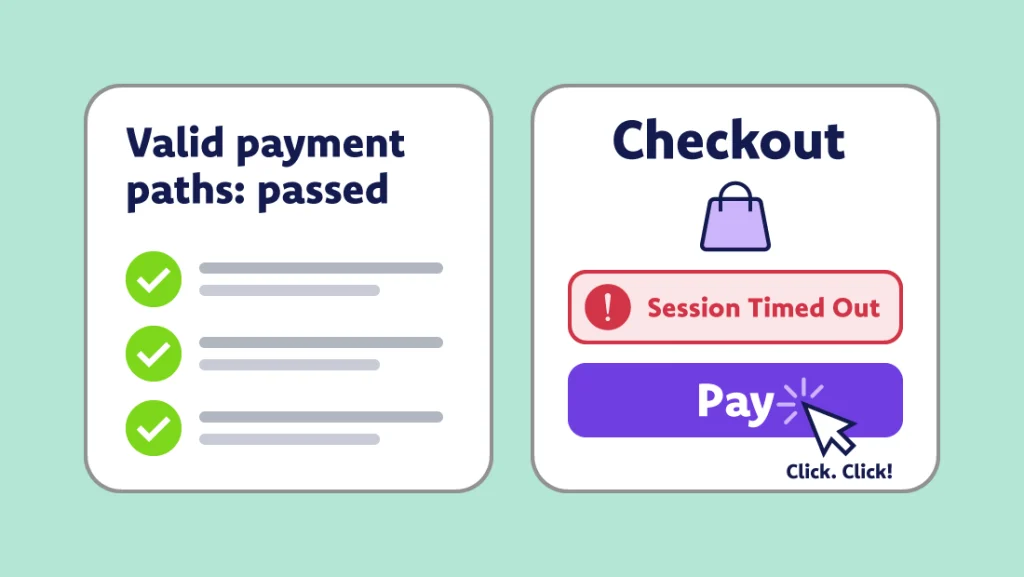
In practice: an AI tool asked to test a checkout flow generates 40 cases covering every valid payment path and misses the one where a user’s session times out mid-payment and they hit “pay” twice. Nothing in the spec says to test that. A tester who’s watched real users panic-click knows to check for it anyway.
2. Context engineering
AI can write a test. It can’t tell you whether the scenario it wrote actually matters to the business, the user, or the moment. That’s context and it’s a skill, not a byproduct of experience.
Build it by: getting closer to the “why” behind a feature before automation starts, not after. The best test ideas still come from understanding intent, not just reading a spec.
3. Trust architecture
As more of the pipeline becomes autonomous – self-healing tests, AI-generated cases, agents reviewing agents – someone has to decide how much autonomy each piece earns, and what happens when it’s wrong.
Build it by: mapping where in your pipeline AI output goes unchecked today, and deciding deliberately, not by default, whether that’s acceptable.
In practice: a self-healing test framework quietly updates a locator every time a UI element moves, so the test keeps passing. That’s useful until the element moved because of a genuine bug, and the “fix” just taught the test to ignore it. Someone needs to own the rule for when self-healing should stop and flag a human instead of patching around the problem.
Be in the room for all the important conversations at AutomationSTAR 2026 – book your tickets now.
4. Strategic questioning
The confidence to challenge what a machine confidently declares “complete” is becoming rarer than the ability to generate more tests. AI doesn’t hedge the way a careful engineer does; it states things as facts even when it’s guessing.
Build it by: practising the question “how do you know?” on AI output the same way you’d practise it on a stakeholder’s assumption.
5. Heuristic pattern recognition
This is the instinct that a system looks correct but still feels wrong – the thing that doesn’t show up in a test report because it was never written down as a rule. It’s built from exposure to failure, not from a framework.
Build it by: keeping a running list of the “something’s off” moments you notice but can’t yet articulate: a response that’s technically correct but feels wrong, a flow that passes every check but still confuses you. Revisit the list monthly. They’re usually the first sighting of a pattern worth naming, long before it becomes a rule anyone could write down.
Finally, none of these are new instincts; testers have always needed them. What’s changed is that AI has taken over the mechanical parts of the job fast enough to make the human parts visible by contrast. The tools will keep changing. The people who understand risk, context, and human impact are the ones who don’t become replaceable by the next one.
Check out the programme to see Laveena’s keynote, and book your AutomationSTAR tickets.