• Skip to main content
Early Bird offer - - Ends 30th Sep - Book Now!

AutomationSTAR

Test Automation Conference Europe

  • Programme
    • AutomationSTAR Team
    • 2026 programme
  • Attend
    • Why Attend
    • Volunteer
    • Location
    • Get approval
    • Bring your Team
    • 2025 Gallery
    • Testimonials
    • Community Hub
  • Exhibit
    • Partner Opportunities
    • Download EXPO Brochure
  • About Us
    • FAQ
    • Blog
    • Test Automation Patterns Wiki
    • Code of Conduct
    • Contact Us
  • Tickets

AutomationSTAR

Sep 21 2026

Who Tests the Tests? The Hidden Risk in AI-Generated Test Cases

A test suite goes green across the board. Every check passes, and the release ships to production. Then the support tickets start coming in: a regression got through, something the tests were supposed to catch. Nobody investigates too deeply, since it happened only once and could easily have been an isolated case.

Then it happens again. The same pattern repeats: a green suite, a real bug, and a gap nobody can explain. That is when teams finally start asking the question they should have asked from the beginning: did these tests ever actually work, or did they simply never fail?

That question matters more now than it did two years ago because AI can write test cases in seconds, allowing teams to generate large numbers of tests in a fraction of the time. The problem is that teams can quickly end up with a suite full of tests that look thorough but fail to catch the bugs that matter. A green checkmark tells you that a test passed, but it says nothing about whether that test was ever capable of catching a real bug.

The AI doesn’t know your product, it’s guessing

An AI model writing a test case doesn’t know your product. It knows patterns. It has seen thousands of checkout flows, login forms, and API calls, and when you ask it to test yours, it draws on what those examples have in common. That’s often a reasonable starting point, since the basic structure of a checkout test is fairly predictable across products. But looking like a good test and actually checking the right thing are not the same, and the model has no way to tell the difference on its own.

Left unchecked, the model guesses. It might assert that a page loaded, that a field is not empty, that a button exists, none of which tell you the feature actually works the way your business needs it to. The test runs, returns green, and sits in your suite as false confidence.

Does this test actually earn its green checkmark?
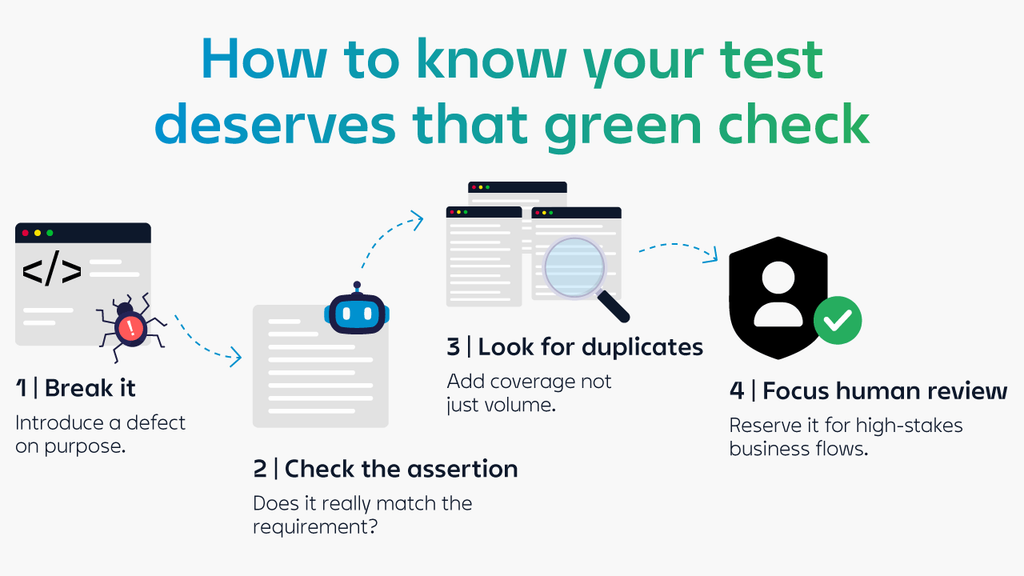
Take a concrete case: an AI tool generates a test for a checkout discount code. The test enters a code, clicks apply, and checks that the page didn’t show an error. It passes. Should you trust it?

Here’s what actually you should do:

Break the code on purpose: this is one of the most reliable checks you can run, so it deserves close attention. Go into the discount logic and deliberately break it: make the discount apply twice, ignore the expiry date, or apply to an already-discounted item. If the test still passes after you’ve broken the logic it is meant to protect, it was never checking the right thing. This is called mutation testing. Instead of asking, “Does the test pass?”, it asks, “Can this test fail when it should?” Gartner recommends this approach for teams using AI to expand test coverage, since AI-generated tests can lack the depth needed to catch real defects on their own. In practice, you create several broken versions of the discount logic and check that the test catches each one. Any failure to detect a mutation tells you exactly what needs to be fixed before you can trust the green result.

Have a second AI model check the assertion: Once a test survives mutation testing, ask a different question: does its assertion actually match the requirement, or does it just confirm that something happened? For the discount code, the requirement isn’t simply that no error appears. It’s that the discount matches what the code entitles the customer to and that the order total reflects it correctly. A second model can compare the assertion against the written requirement and flag any mismatch. The goal is to close the gap between a test that confirms something happened and one that confirms the right thing happened.

Check for near-duplicates: AI tools generate tests quickly, but that can also mean generating the same test several times with small variations. If you already have four tests confirming that a discount code works correctly, a fifth that only changes the code string is not adding coverage. It is just adding another test to maintain. The ASTQB calls this “false confidence from volume”: a large test suite can look thorough while still leaving the same risks uncovered. Merge tests that overlap heavily and keep near-duplicates only when they cover a genuinely different path, such as combining a discount code with a gift card.

Save human review for what matters most: Not every test needs the same level of scrutiny. Sonar’s 2026 State of Code Developer Survey found that 96% of developers don’t fully trust AI-generated code to be functionally correct, while only 48% always check it before committing. The same caution should apply to AI-generated tests, particularly in areas where a failure can have a direct impact on customers and the business. Pricing, payments, and authentication deserve closer attention: a discount applied twice, a payment processed more than once, or a login that gives access to the wrong session can all have serious consequences. Reserve manual review for these high-stakes flows, while using mutation testing and AI-assisted review to validate the rest of the suite.

The next question testingON is built to answer
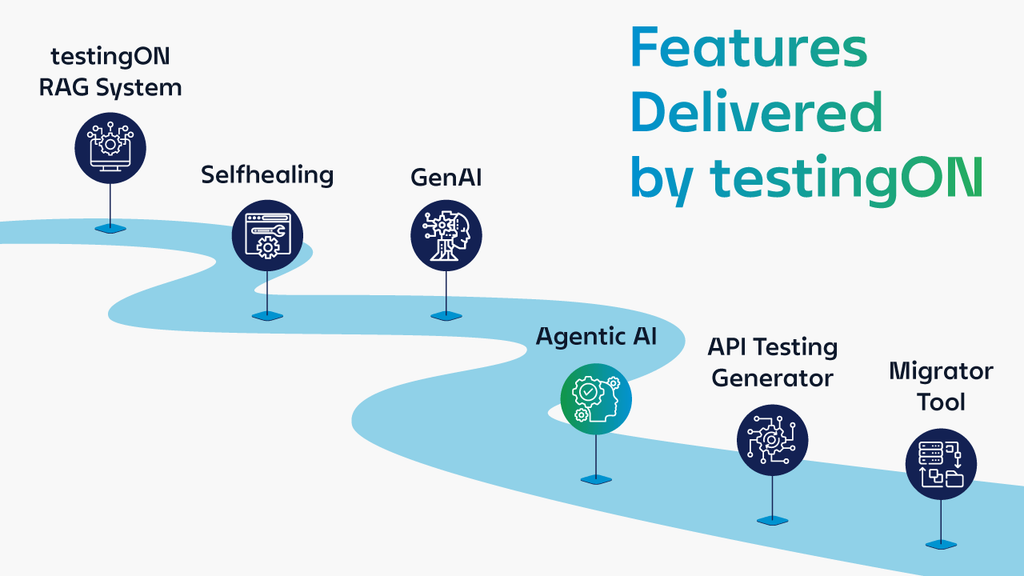
Most AI test-generation tools, including the ones enterprise QA teams are piloting right now, stop at generation. They write the test, hand it back green, and move on. They don’t run the checks described above, they don’t break the code on purpose, they don’t flag near-duplicates, they don’t know which paths are high-stakes enough to need a human. That’s true of most AI test-generation vendors too: speed is the pitch, and validation is left entirely to whoever’s using the tool.

We built testingON’s roadmap around closing that specific gap. Under an initiative we’re calling Agentic AI, we’re building an agent whose job is exactly what this post describes: taking a generated test and verifying it can actually catch a real defect, not just checking that it runs green. It sits alongside a companion agent that generates tests overnight against new user stories, and another that runs tests in the background and reports on execution results and performance, so generation, validation, and execution work as one connected process instead of three separate

tools bolted together. This is a roadmap direction we’re actively building toward, not a shipped feature today, but it’s a direct answer to the exact problem this post lays out.

If you’re piloting AI test generation and want to talk about how to validate what it’s producing before it reaches production, see what testingON is building.

Author

Tiago Honorato, Quality Management DevOps & Automation Associate Director at Noesis

I am a technology leader with more than 18 years of experience in Software Engineering, Quality Assurance, Product Innovation, and Digital Transformation.

I started my career as a Software Developer at Nokia Siemens Networks after completing my Master’s degree in Computer Science in Lisbon, Portugal. Shortly after, I embraced a new challenge at Noesis, where I founded and scaled the company’s Test Automation practice, helping clients accelerate their software delivery lifecycle and significantly improve quality standards.

Although I transitioned from development to Quality Assurance, I have always maintained a strong connection to software engineering — combining deep technical expertise with strategic quality vision. Over time, I led multiple initiatives across test automation, application development, and quality transformation programs for major enterprise clients.

Leveraging this cross-functional experience, I conceived and led the creation of testingON — a test management and automation platform designed to reduce testing time while increasing coverage and enabling non-technical users to actively contribute to quality processes. The platform integrates with leading test management, CI/CD, and project management tools and is currently used by major Telco, Retail, Banking, and Insurance organizations in Portugal and Brazil.

I later accepted a new challenge at NTT DATA, where I served as Senior Manager responsible for the Quality Assurance & Testing offering, leading strategic accounts, strengthening delivery capabilities, and expanding quality services.

Subsequently, I returned to Noesis as Associate Director to lead the strategic evolution of testingON. In this role, I am responsible for product vision, innovation roadmap, and growth strategy — including the integration of Generative AI capabilities and the modernization of the platform’s architecture to ensure scalability, cloud readiness, and long-term competitiveness.

testingON are Platinum Partners at AutomationSTAR Conference EXPO 2026. Join us in Antwerp 4-5th November 2026.
· Categorized: AutomationSTAR · Tagged: 2026, EXPO

Sep 14 2026

Meet BQA and Teammaite at AutomationSTAR: from testing expertise to AI-powered quality

Visit BQA and Teammaite at AutomationSTAR and discover how testing expertise, AI and automation come together – with AI as the accelerator and the professional in the driver-seat.

AI-powered development is delivering code faster, sometimes producing an entire feature in a single iteration. Testers therefore need to analyse specifications, risks, test strategy, coverage and automation just as quickly – without sacrificing quality.

That raises a practical question:

How do you stay relevant, valuable and effective as quality becomes more AI-driven?

At AutomationSTAR, BQA and Teammaite will explore that question with testers, automation engineers, QA leads and business owners. Our message is simple: AI should not replace testing expertise; it should make that expertise more powerful.

Quality Starts Before Testing Starts

Requirements often look clear until testing reveals the gaps: exception flows are undefined, acceptance criteria are not measurable, risks are unclear or the business expectation does not match what was built.

BQA therefore believes quality must move upstream. Requirements, user stories and acceptance criteria should be analysed before development starts, with risks and test ideas linked to business intent from the beginning.

With AI support, Teammaite can analyse requirements for ambiguity, missing information, inconsistencies and testability, helping teams build a stronger foundation for test design and automation.

The challenge is not simply generating tests faster, but deciding what should be tested:

  • What does the specification really mean?
  • Are the requirements complete, unambiguous and testable?
  • Where are the biggest product and business risks?
  • Which test techniques and level of coverage are appropriate?
  • How do we translate those choices into existing processes and tools in a traceable way?

From Dpecification to the Right Test Coverage

At our stand, we will demonstrate one recognisable end-to-end quality flow:

Specifications -> requirements -> quality improvement -> risk analysis -> test strategy -> test design -> execution and management

Teammaite can process documents, models, tables or existing tickets, while a BQA consultant determines the appropriate context and extraction approach.

Teammaite then identifies ambiguity, inconsistencies, missing information and testability issues. AI can propose product risks, impact and priorities, but consultants and stakeholders validate the business context and risk weighting.

Based on clearer requirements and validated risks, teams can define relevant test levels, test types, techniques and desired coverage.

The goal is not automatically more tests, but targeted and explainable coverage of the risks that matter.

From Tester to AI Test Orchestrator

AI accelerates the process, but it does not remove the need for testing expertise. Experienced testers understand context, recognise risk, judge whether test cases are meaningful and decide what should be automated or explored by people.

BQA calls this role the AI test orchestrator: a quality professional who uses AI deliberately, critically and effectively across the software development lifecycle. For test managers and QA leads, governance, prioritisation, traceability and release confidence remain essential.

The key question is no longer only:

“Can AI create tests?”

It is:

“Can we explain why these tests cover the right risks?”

That is the central question behind our stand at AutomationSTAR.

AI in Control: People Make the Decisions

Responsible AI must be visible in the way quality decisions are made: AI makes proposals; people make decisions.

Important steps can include review and approval. Sources, assumptions, modifications and decisions remain traceable, uncertainty is explicit, and the degree of autonomy can be adjusted to the organisation and the risk involved.

Teammaite delivers the intelligent, integrated workflow. BQA provides the human link – from selecting the approach and facilitating stakeholder discussions to risk analysis, test strategy, governance and implementation.

Connect AI to the Tools you Already Use

AI-supported quality should not become an isolated experiment. Approved results need to fit the organisation’s existing way of working.

The approach can connect with tools such as Robot Framework, Testersuite, Jira and Azure DevOps while maintaining traceability from specification through requirements and tests to findings.

Together, BQA and Teammaite support the full quality flow: requirements analysis, test strategy, test cases, automation and release insight.

Teammaite brings the AI capability; BQA brings experienced consultants who understand testing, test management, automation, governance and software delivery in complex organisations.

AI tooling alone does not change an organisation. People, process and implementation determine whether AI becomes a useful colleague or just another experiment.

Bring Us Your Specification

At AutomationSTAR, we want to go beyond a generic AI product presentation.

Bring a specification or sample requirement and take the spec-to-strategy challenge.

In a few minutes, Teammaite can highlight potential improvements, risks and suggested test coverage. A BQA consultant will discuss which proposals make sense, which assumptions need challenging, where human judgement is required and what integration into your quality process could look like.

You leave with a compact AI-in-control quick scan and a clearer view of what AI-supported quality could mean for your organisation.

Come and Challenge Us

We believe in practical quality improvement, not AI hype for its own sake.

Come to the BQA and Teammaite stand with a testing challenge, requirements problem, automation bottleneck, management concern or simply one existing specification.

Ask us what AI can do, where human expertise remains essential and how your team can move from specification to improved requirements, validated risks, an appropriate test strategy and integrated test facts.

And come prepared for one question from us:

Can you explain why your current tests cover the right risks?

Authors:

Sander Ulrich – Teammaite

Gerben Braakman – BQA       

Frank van der Kuur – BQA

BQA are exhibitors at AutomationSTAR Conference EXPO 2026. Join us in Antwerp 4-5th November 2026.

· Categorized: AutomationSTAR · Tagged: 2026, EXPO

Sep 10 2026

Six Test Automation Trends That Will Actually Change Your Week in 2026

What do this year’s conference submissions reveal about where test automation is heading? As a member of the AutomationSTAR 2026 Programme Committee, Gomathi Ramalingam has been reviewing the ideas and experiences practitioners want to share. Here, she picks out six trends that stood out—and offers a practical starting point for each.

You can join her tutorial, AI Testing Dojo: Build, Break & Master Agents, at AutomationSTAR 2026.

Every year someone publishes a list of testing trends, and every year most of it is weather. It rolls over the industry, makes a lot of noise, and leaves your Tuesday unchanged. So when we read through the AutomationSTAR 2026 submissions on the programme committee, I was looking for something different: not what people are excited about, but what is already altering the day-to-day work of the teams behind the submissions.

Two numbers stuck with me. Around two-thirds of this year’s abstracts mention AI, LLMs or agents in some form. And ‘trust’ turned up in roughly one in five, which is a vocabulary shift I have never seen at this scale before.

Put those together and you have the story of 2026: the industry has stopped asking whether AI will write our tests and started asking how on earth we know when it has done it well.

Here are the six trends I think deserve your attention, each with one thing you can start this week.

1. Agentic testing is moving from demo to duty

For the last two years, ‘AI in testing’ mostly meant a chat window that produced plausible-looking test cases. That picture is changing. The pattern now showing up in real pipelines is a set of specialised agents with narrow jobs: a planner that explores the application and drafts a plan, a generator that turns the plan into executable code, and a healer that re-runs failures and repairs broken locators.

Playwright has formalised exactly this planner–generator–healer split and the Model Context Protocol (MCP) has become the standard plumbing that lets an agent see an accessibility tree rather than a wall of raw HTML.

The reason this matters is that decomposition is a hallucination-control strategy. An agent with one small, checkable job is far easier to audit than a monolith that “does testing”.

Do this: Pick one narrow, boring job in your pipeline, such as triaging failed runs or proposing locator fixes and give it to an agent with a human approval step. Do not start with “generate our regression suite”.

2. Trust has replaced coverage as the metric that matters

The World Quality Report 2025–26 found that 89% of organisations are piloting or deploying GenAI in quality engineering, yet only 15% have managed enterprise-wide adoption. The most telling figure is the barrier list: 60% cite hallucination and reliability as a blocker. Teams are not short of AI-generated tests. They are short of a reason to believe them.

A green tick from a test the model wrote, asserting a value the model also invented, is not evidence of anything. I have watched a beautifully formatted suite pass at 100% because every assertion was tautological. The work of a tester in 2026 is increasingly to be the accountability layer for output that was produced faster than any human could read it.

Do this: Add a quality gate before AI-generated tests are merged. Mine has six checks, but even three will change your outcomes: does each test assert something the code could plausibly get wrong, does it reference a real endpoint or element, and would it fail if the feature were deleted?

3. AI-generated code needs AI-aware testing

It is not only tests being generated. A large and growing share of production code now starts life in a model, and the trust gap is widening: in Stack Overflow’s 2025 developer survey, 84% of developers use or plan to use AI tools, yet 46% say they do not trust the accuracy of the output, up from 31% the year before. That code has characteristic failure modes. It handles the happy path elegantly, invents APIs that do not exist, and quietly drops edge cases that were never in the prompt.
This is good news for testers. Classic technique is back in fashion. Boundary values, negative paths, state transitions and idempotency checks are precisely the things a model skips when it is optimising for “looks correct”.

Do this: When a change is flagged as AI-assisted, run a short, explicit review checklist against it rather than the same one you use for human code. The checklist should include “which inputs did the prompt not mention?”

Be in the room for all the important conversations at AutomationSTAR 2026 – book your tickets now.

4. Flaky tests are finally being priced

For years flaky tests were tolerated as a tax. This year’s submissions and blog posts treat them as a cost line, and that reframing is overdue. Every retry, every “re-run and it passed”, every engineer who has learned to ignore red builds is a measurable drain on delivery. And in an agentic world it is worse: an agent that learns your suite is noisy will learn to retry, heal and paper over, which is exactly the behaviour you do not want automated.

Do this: Spend an hour producing a flaky test audit. List the tests that failed and then passed on retry in the last thirty days, with the minutes of pipeline time they consumed. Take the number to whoever owns the roadmap. It is a far more persuasive argument than “we need to fix tech debt”.

5. API-first testing is the natural habitat for AI

There is a reason so much of the serious agentic work is happening at the API layer rather than the UI. APIs are text. Specifications are text. Requests and responses are structured, deterministic and cheap to run thousands of times. A model reasoning over an OpenAPI document is operating in its comfort zone; a model reasoning over a rendered DOM is guessing at pixels.
Contract testing fits this beautifully. A contract is a machine-readable statement of intent, which means it can serve as both the prompt and the guardrail for generated tests.

Do this: If you are going to let a model generate tests anywhere, start with your APIs, feed it the spec rather than a description and measure hallucination rate per prompt. You will quickly discover that some ways of asking produce reliable tests and others produce fiction. Keep a scored library of the ones that work.

6. The tester’s skill stack is shifting, and it is not towards prompting

The tempting conclusion from all of the above is that testers need to become prompt engineers. I do not think that is quite right. The skills the 2026 submissions actually reward are older and harder: writing precise context, designing an experiment that can distinguish a good output from a convincing one, and thinking adversarially about a system that will confidently tell you it is fine.
That is testing. It always was. The difference is that the system under test now includes the tool doing the testing.

Do this: Give your team a low-stakes sandbox and a challenge: build a small testing agent, then break it. Nothing calibrates judgement about where AI helps and where it is dangerously wrong faster than watching your own agent fail. It is the format I am using for a hands-on tutorial at AutomationSTAR this November, and it is the approach I would recommend whether or not you attend.

The thread running through all six

Automation has always been about removing humans from the parts of the work that do not need them. What 2026 is clarifying is which parts those are. Generation is being automated. Judgement is not. The teams that will do well are the ones that treat every green tick from an AI as a claim to be verified, not a result to be celebrated.

Want to take these ideas further? Join us at AutomationSTAR in Antwerp on 4–5 November for practical talks, hands-on tutorials and conversations with the people putting them to work. Explore the programme, and find the sessions that tackle your team’s next challenge. Check out and book your AutomationSTAR tickets.

Book tickets

· Categorized: AutomationSTAR, Uncategorized · Tagged: 2026

Sep 08 2026

When AI Can Generate the Tests, What Is QE For?

Ahead of her AutomationSTAR keynote, Quality Engineering Has an Identity Crisis… and AI Just Walked Into the Room, Laveena Ramchandani explores five skills that will matter more as AI takes on more of the mechanical work of testing.

Ask ten companies what Quality Engineering means today and you’ll get ten different answers – and at least three job titles nobody can properly explain.

That’s not a new problem. Manual testing became automation. Automation became Agile. Agile became DevOps. Each time, the job title changed and the core question stayed the same: what exactly are we here to do?

AI has just made that question urgent again. It can generate hundreds of test cases in seconds and produce dashboards that look impressively complete. What it can’t do is imagine a frustrated customer at midnight, trusting a product that quietly fails them at exactly the wrong moment. That gap between “the dashboard is green” and “the product is actually trustworthy” is where the next generation of QE skills live.

Here are five worth building now.

1. Judgment over green ticks

A passing test suite has never meant the same thing as a working product, but AI-generated coverage makes that gap easier to hide. When hundreds of test cases can be produced in minutes, the volume of green ticks stops being a reliable signal on its own.

Build it by: treating every AI-generated test suite as a first draft, not a final answer. Ask what it didn’t think to test, not just what it covered.

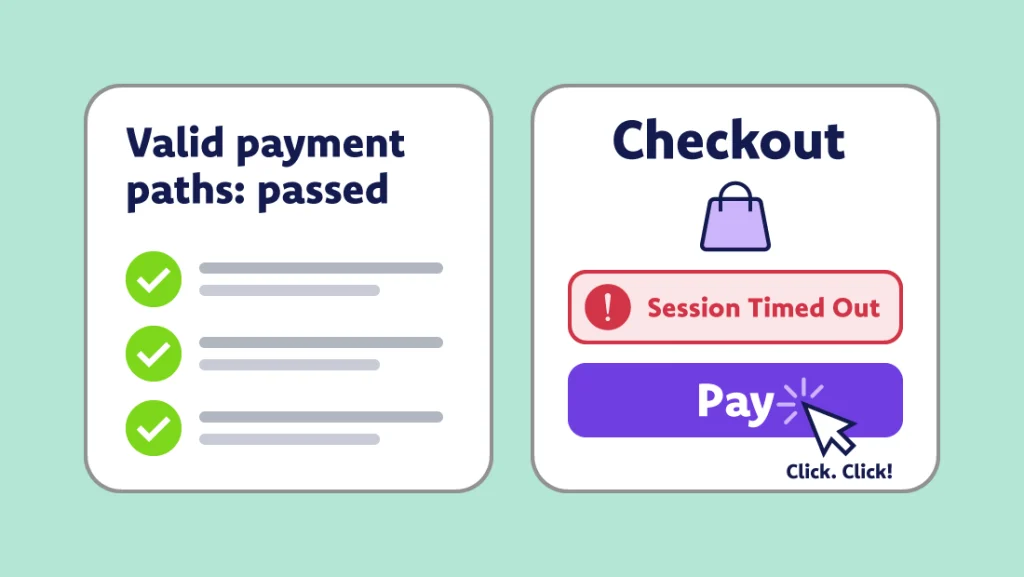
In practice: an AI tool asked to test a checkout flow generates 40 cases covering every valid payment path and misses the one where a user’s session times out mid-payment and they hit “pay” twice. Nothing in the spec says to test that. A tester who’s watched real users panic-click knows to check for it anyway.

2. Context engineering

AI can write a test. It can’t tell you whether the scenario it wrote actually matters to the business, the user, or the moment. That’s context and it’s a skill, not a byproduct of experience.

Build it by: getting closer to the “why” behind a feature before automation starts, not after. The best test ideas still come from understanding intent, not just reading a spec.

3. Trust architecture

As more of the pipeline becomes autonomous – self-healing tests, AI-generated cases, agents reviewing agents – someone has to decide how much autonomy each piece earns, and what happens when it’s wrong.

Build it by: mapping where in your pipeline AI output goes unchecked today, and deciding deliberately, not by default, whether that’s acceptable.

In practice: a self-healing test framework quietly updates a locator every time a UI element moves, so the test keeps passing. That’s useful until the element moved because of a genuine bug, and the “fix” just taught the test to ignore it. Someone needs to own the rule for when self-healing should stop and flag a human instead of patching around the problem.

Be in the room for all the important conversations at AutomationSTAR 2026 – book your tickets now.

4. Strategic questioning

The confidence to challenge what a machine confidently declares “complete” is becoming rarer than the ability to generate more tests. AI doesn’t hedge the way a careful engineer does; it states things as facts even when it’s guessing.

Build it by: practising the question “how do you know?” on AI output the same way you’d practise it on a stakeholder’s assumption.

5. Heuristic pattern recognition

This is the instinct that a system looks correct but still feels wrong – the thing that doesn’t show up in a test report because it was never written down as a rule. It’s built from exposure to failure, not from a framework.

Build it by: keeping a running list of the “something’s off” moments you notice but can’t yet articulate: a response that’s technically correct but feels wrong, a flow that passes every check but still confuses you. Revisit the list monthly. They’re usually the first sighting of a pattern worth naming, long before it becomes a rule anyone could write down.

Finally, none of these are new instincts; testers have always needed them. What’s changed is that AI has taken over the mechanical parts of the job fast enough to make the human parts visible by contrast. The tools will keep changing. The people who understand risk, context, and human impact are the ones who don’t become replaceable by the next one.

Check out the programme to see Laveena’s keynote, and book your AutomationSTAR tickets.

See tickets

· Categorized: AutomationSTAR · Tagged: 2026

Sep 07 2026

The Keyword Is the Contract

How the right layers of abstraction improve collaboration, maintainability and technical flexibility

Open a test specification and you read: the customer places an order. Open the automation for the
same test and you find forty lines of selectors, waits and assertions. Both claim to describe one test.
Three sprints later a checkout step has moved, someone patched the code but not the specification,
and nobody can say which one is still true.

Anyone who has maintained a test suite for a year knows the situation. It isn’t a communication
problem. It’s a missing interface.

The people best placed to decide what to test are usually not the people who can automate it.
Business testers understand processes, requirements and the scenarios that matter. Automation
engineers understand frameworks, interfaces and the technical details of the system under test.
Traditional automation puts the two groups in a relay race: first specify, then automate. Every
change to the specification means a change to the code, and unless someone keeps paying the
manual cost of alignment, the two artifacts drift.

That drift was survivable when releases came quarterly. At weekly, it isn’t. Cycles get shorter,
expectations keep rising, and a specification nobody trusts stops being documentation and becomes
a liability.

More discipline won’t fix it. Abstraction will, applied in more places than most teams think.

Why Abstraction

Clean code has a rule for it: single level of abstraction. A function works on one level of detail instead
of mixing business logic with string handling. What you get is readability, understandability,
maintainability and reuse. Testing can borrow the principle, and two standards tell you where to put
it.

Abstraction 1: The Test Automation Architecture

ISTQB’s Generic Test Automation Architecture, laid out in the CTAL-TAE syllabus, applies the same
idea to the automation solution and separates four layers:

  • Test generation — designing test cases, deciding what to test
  • Test definition — test suites, test cases, test data, the reusable keyword library
  • Test execution — the engine that runs the tests, logs and reports
  • Test adaptation — the code that talks to the interfaces of the system under test

What makes the model useful is the separation it enforces. A change in one layer rarely forces a
change in another. A re-labelled button hits the adaptation layer, not two hundred test cases. Swap a UI-driven check for an API call on the same business step and the test definition layer never notices. The layers tell you where the boundaries belong, not how an intent stated at the top arrives as
executable code at the bottom.

Abstraction 2: The Test Specification

Keyword-driven testing is the answer. ISO/IEC/IEEE 29119-5 describes keyword-driven testing, and
the second edition from 2024 is explicit about hierarchy. At the bottom sit generic technical
keywords such as “Click” , “ Fill Text ” or “Get Element States ” . Those get composed
into business-level keywords: “ Log in as a registered customer ” , “ Place an
order ”
. A test case is then a sequence of business keywords plus test data, readable by anyone
who knows the domain, with no code in sight.

The hierarchy itself isn’t the most interesting part. What it produces is a contract. The keyword name
and its parameters are the interface between the two worlds. A business tester can reorder steps,
add a data variant or build a new test case from existing keywords without touching automation
code. An automation engineer can rewrite whatever happens behind “ Place an order ” , new
UI, new API, new library, without invalidating a single test case. Each side changes what it owns. The
artifacts stay aligned because the thing that matters exists only once: the keyword.

Abstraction 3: The Tooling

Here is the step most teams skip. If the layers really are separate, no single tool must cover all of
them. That matters, because the two groups don’t want the same tool. Ask a business tester to
specify tests in VS Code and you lose them; an IDE isn’t their workplace and Git isn’t their
vocabulary. Ask an automation engineer to implement technical steps by clicking through a GUI and
you take away autocompletion, refactoring, version control and code review, which is most of what
makes engineering possible.


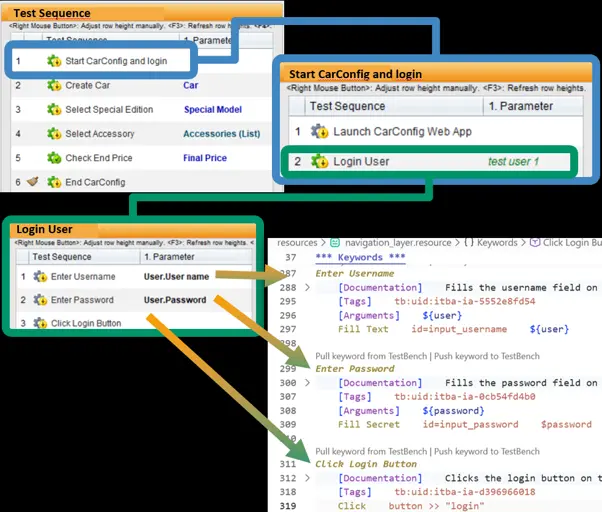
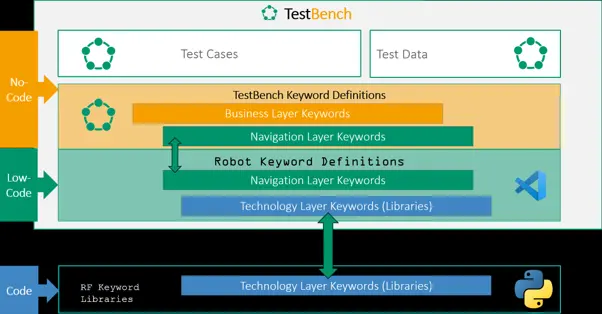
So choose per layer, then connect the layers. In our case, TestBench covers test definition, entirely
no-code: business testers maintain keywords and test data in a GUI and assemble test cases from
them. Robot Framework and VS Code cover the implementation, low-code where the existing Robot
Framework libraries suffice and real Python in user keywords where they don’t.
testbench2robotframework generates Robot Framework suites from a TestBench report and writes
the results back, and the TestBench extension for VS Code keeps keywords, descriptions and test
data in sync.

29119-5 expects this. The standard defines requirements for a common data exchange format so
that tools from different vendors can hand test cases, keywords and test data to each other.
Exchanging artifacts between tools isn’t a workaround for the all-in-one product nobody sells; the
standard treats it as the normal case.

Where It Breaks

Abstraction isn’t free. Keyword libraries grow, and an unmaintained catalogue of hundreds of nearidentical keywords is worse than none: nobody finds the right one, so everybody adds another.
Keywords cut too finely (Click button, Enter text) push technical detail straight back into the test
specification and cancel out the benefit. Layers hold only if someone owns the keyword library, if
naming conventions are agreed and enforced, and if keywords get reviewed as seriously as code.
Standards hand you a structure. Nobody hands you the discipline to keep it clean.

What You Actually Gain

Two things. A shared artifact that a business tester can read and an engineer can execute. And, less
obviously, a shared vocabulary. Domain-driven design calls this a ubiquitous language: one rigorous
set of terms used by domain experts and developers alike, in conversation and in the code. Keyword driven testing produces exactly that as a by-product. When “Place an order” means the same thing in a review meeting, in a test case and in a Robot Framework keyword, the two groups have stopped translating between worlds. They are editing the same sentence.

Further Reading

Leave Complexity Behind: No-Code Test Automation with Low-Code integration via Robot Framework and TestBench

Author

Falk Altrock, Product Owner TestBench
imbus AG

TestBench are exhibitors at AutomationSTAR Conference EXPO 2026. Join us in Antwerp 4-5th November 2026.

· Categorized: AutomationSTAR · Tagged: 2026, EXPO

  • Page 1
  • Page 2
  • Page 3
  • Interim pages omitted …
  • Page 9
  • Go to Next Page »

Copyright © 2026 · Impressum · Privacy · T&C

part of the