AI coding agents can now build entire features from a single prompt. Tools like Claude Code, Codex CLI, and Cursor write code quickly and confidently. But there is a gap in this workflow that testers will recognize immediately: writing code and verifying that it works are two different disciplines.
The Verification Gap
Large language models are non-deterministic. The same prompt can produce different output on different runs, and agents occasionally hallucinate behavior that does not exist. One common workaround is asking the agent to review its own work, but self-verification in a loop is expensive and circular. An agent grading its own homework is not evidence.
What is missing is what testers have always insisted on: an independent, repeatable check against the real system. For web applications, that means opening an actual browser, executing the user journey step by step, and returning a clear pass or fail.
Closing the Gap from the Terminal
This is the problem Kane CLI, from TestMu AI, sets out to solve. It brings the KaneAI testing agent into the terminal, where both developers and coding agents already work. You describe a flow in natural language, such as a login, a form validation, or a checkout journey. Kane CLI runs it in a local Chrome browser and returns a deterministic result with a shareable evidence link containing video and a step trace.
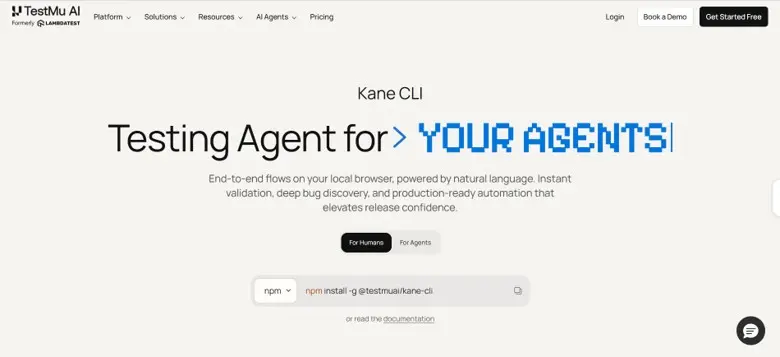
The design choices reflect sound testing principles:
- Deterministic results. Every run ends in a binary pass or fail, backed by a real browser execution rather than the agent’s own opinion.
- Human-realistic actions. It only performs actions a real user could take inside the viewport. It never injects custom JavaScript to bypass validations and force a pass.
- Resilient, repeatable tests. Vision-based waiting detects loaders and animations, and self-healing absorbs cosmetic UI changes, so tests survive across runs and environments.
- Human-in-the-loop. When a flow hits an OTP or CAPTCHA, it pauses, asks a human to complete that step, and continues.
Where This Fits
For agents, verification happens through a structured agent mode: the coding agent calls Kane CLI, reads the machine-readable result, and decides whether to fix, continue, or escalate to a human. For teams, flows can export to native Playwright code and run headlessly in CI/CD pipelines.
The broader lesson holds regardless of tooling: as agents take on more of the building, independent validation becomes more important, not less. Verification, like testing itself, works best when it is decoupled from the thing being verified.
Author

Mudit Singh Co-Founder at TestMu AI
Mudit Singh, Co-Founder and Head of Growth at TestMu AI (Formerly LambdaTest), is a dynamic force in the world of software innovation. With over a decade of expertise in building and scaling remarkable software products, Mudit has played a pivotal role in TestMu AI’s mission to transform the software testing landscape.
His strategic vision is centered around shifting testing ecosystems to the cloud, optimizing efficiency, and driving tangible business outcomes. Known for his hands-on approach to product development, Mudit thrives on creating solutions that deliver immense value to customers. When he’s not pushing the boundaries of product and growth, Mudit enjoys exploring the intersection of technology and business trends, always staying ahead of the curve.
TestMu AI are an AutomationSTAR 2026 exhibitor. Join us in Antwerp 4-5 Nov 2026.