This year’s Conference theme of “Future Skills” is not just a theme – it is being echoed by the data we are receiving for the Call for Speakers on the roles of the future and the skills that will define them.
Curious about how your job will look like in 3 years?
Instead of reading job advertisements from the past – our speakers are tackling the problems they face today with the tools they use and are frantically searching for the necessary skills to keep their job.
The AutomationSTAR Call for Speakers this year is even more valuable for those who work in test automation and quality in general. This year’s Programme Committee analysed all the submissions for the opportunity to speak at this event, and the result of such analysis paints a picture of what working in test automation will look like in 3 years from now.
If you work in quality this is THE event you MUST attend in 2026. Here is why.
The topic map has been redrawn
Three years ago, our topic categories were organised around technologies: web, API, mobile, performance. Look at where submissions landed this year.
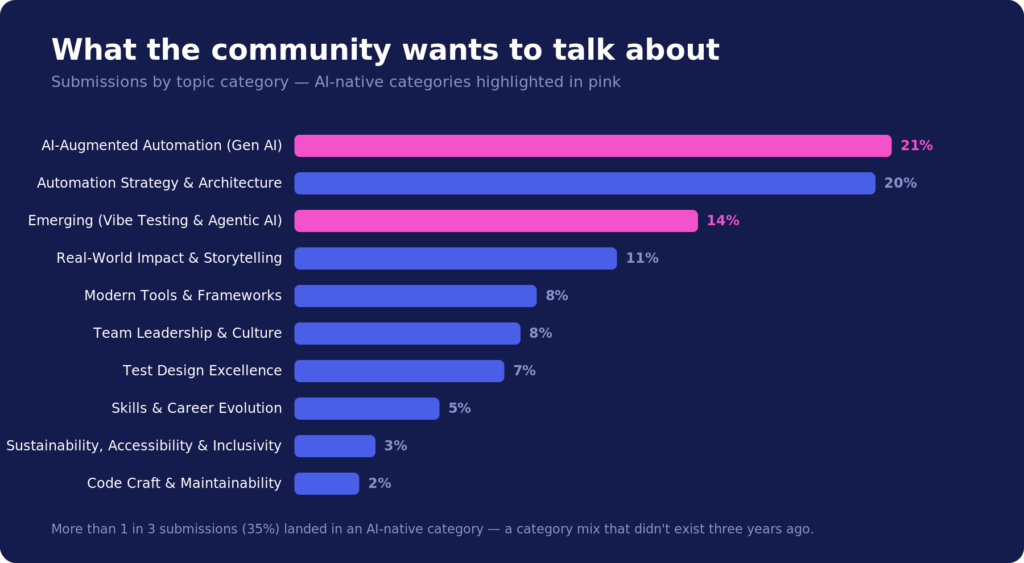
Of the submissions we received 35% fell into what we’re calling ‘AI-native’ categories of work such as ‘vibe testing’, ‘agentic AI’ and Gen AI-augmented automation. These categories have naturally evolved in the community and were not created by us for marketing purposes and have since taken off.
Meanwhile the category of Automation Strategy & Architecture retained its position as one of the most popular at 20%. Given the rapid evolution of the tools available for automation this category will continue to be relevant as someone needs to ensure that the automation is working effectively.
Code Craft & Maintainability scored the lowest with 2% of all submitted topics. As we were really excited to start to dive into the many questions and topics how to build something new in the first place, the community is clearly more interested in just building something new instead of taking care of something that has already been built. This is a gap one should be aware of.
The AI wave, measured
“AI is everywhere” is easy to say. Here’s what it looks like in numbers.
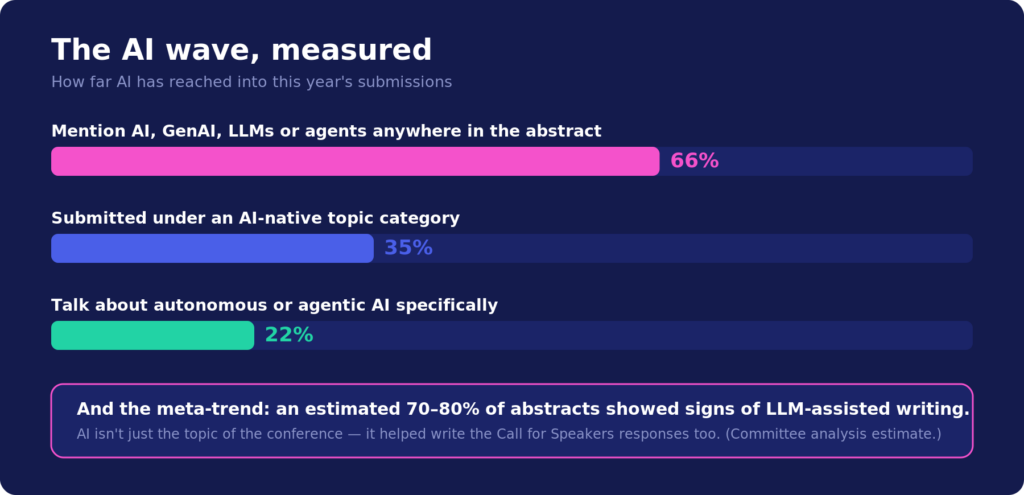
About two-thirds of the abstracts in all areas (design of tests, leadership, etc.) referred to AI, LLMs or agents. Autonomous and agentic AI was mentioned in 22% of the abstracts. On average, the abstracts focusing on AI, LLMs or agents received higher ratings from the committees than the abstracts that did not focus on these topics.
Additional to the former findings, the analysis furthermore detected a meta-trend within the abstracts under review: roughly 70–80% of the abstracts were written with the support of an LLM.
As before, however, when every single abstract was written to perfection using an LLM, the only remaining difference would be the authors’ experience. And this is exactly what the reviewers are trying to find – in line with this year’s review theme.
The vocabulary shift
Perhaps the clearest signal of all: count which words the community reaches for.
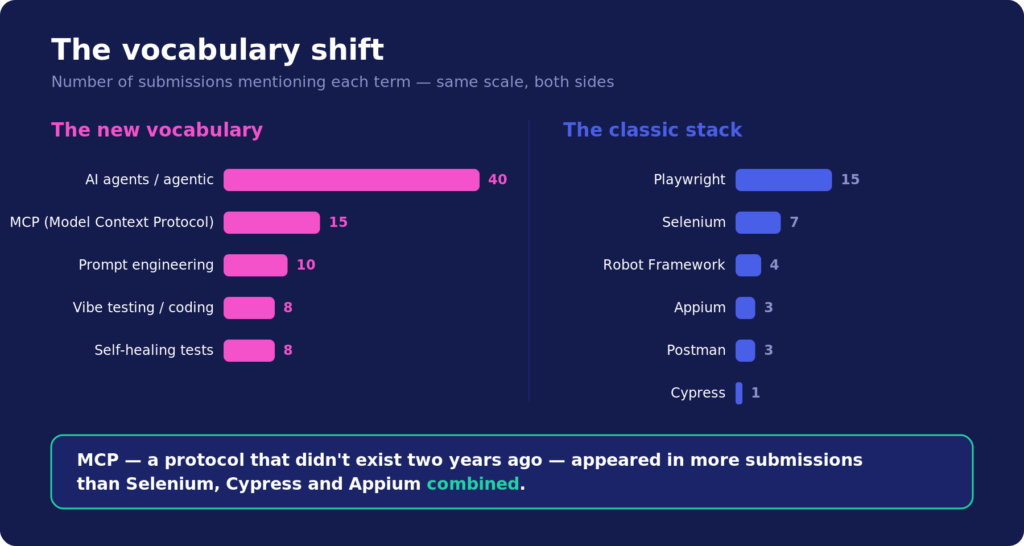
“Agents” and “agentic” were mentioned 40 times. The Model Context Protocol (MCP), for model deployment that was not yet established two years ago, was even mentioned more often than Selenium, Cypress and Appium together. Playwright, the heavyweight automation tool, was even mentioned as often as MCP.
The graph does not mean to suggest that all people have stopped using Selenium and Cypress for running their thousands of test pipelines. Rather, the focus of the test automation discussion has shifted from which test automation framework to use (Selenium, Cypress, Appium, etc.) to how to control, direct, put bounds to, and trust an autonomous test system.
Future Skills: the theme that chose itself
When we set “Future Skills” as this year’s theme, we wondered if the community would engage with it. They did — but not in the way a skills-matrix would predict.
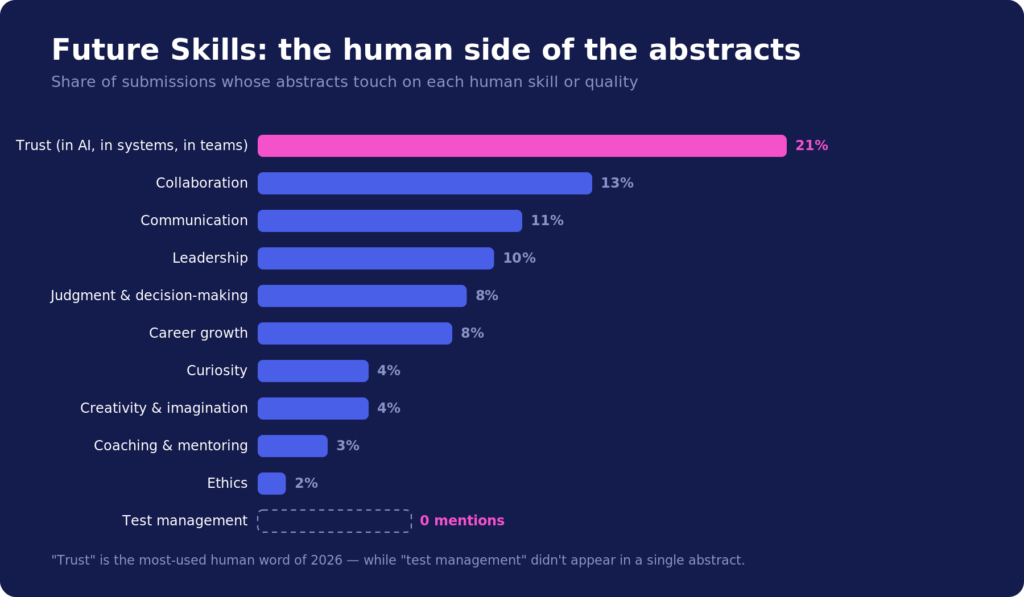
The word that humans keep using in this year’s abstracts is: trust. It appears in 21% of the abstracts. This word is used to discuss the trustworthiness of AI, of different types of of fully autonomous agents, of teams of agents, and of the systems under test by the authors. Also discussed are collaboration, communication, leadership, and judging.
Interesting the term “test management” didn’t make the cut as a keyword in any of the abstracts. What was once a foundational term for a whole conference track a decade ago is now gone from practitioners’ vocabulary and has been replaced with terms that speak to trust, human judgment, and human / AI collaboration.
So here’s the nutshell summary of Future Skills: The mechanical parts of our work are getting covered by automated tools and thus will cease to be our area of work in the future.
What will remain with us, is what makes us human. That is: knowing when the green of your dashboard is only painting it green and thus might be lying to you.
Deciding how much autonomy to give to which kind of autonomous agent. Explaining risks to people who have to make decisions on the basis of that risk.
Fresh stories, seasoned voices
One more finding we loved.
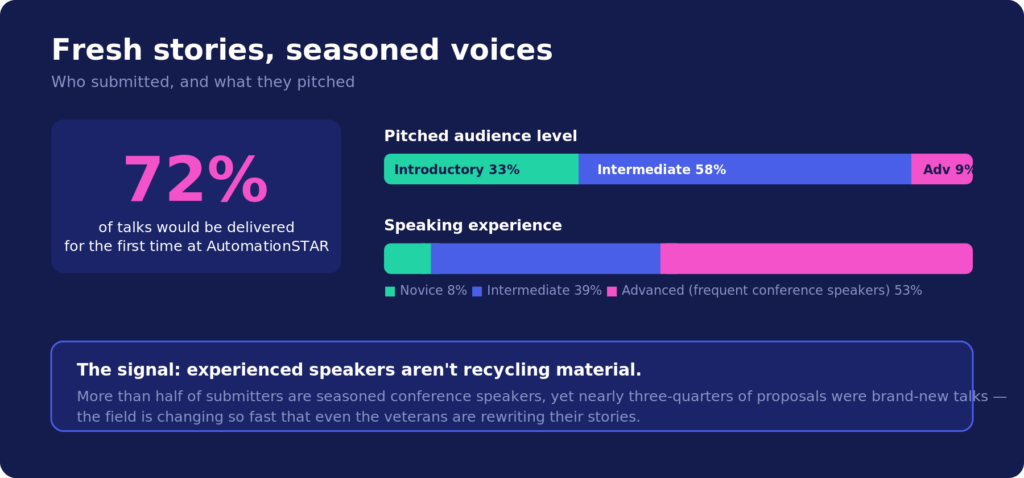
72% of proposed talks will be new to AutomationSTAR 2026. 58% of submitters are experienced conference speakers, yet they are rewriting their stories as the automation field is changing very quickly.
The audience-level mix for the proposed talks is 58% intermediate, 33% introductory, 9% advanced. The field of automation is being reinvented fast, and so there is a point at which everyone is a beginner for that section of the discipline. Hence the community will be presenting talks for this audience.
From everywhere, to Antwerp
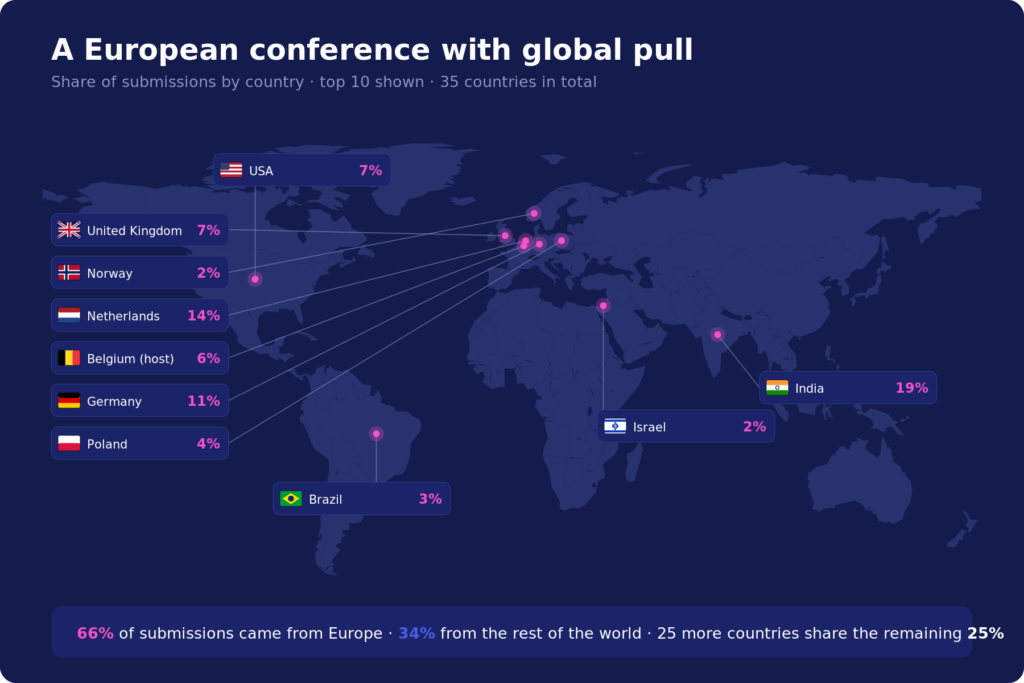
We received submissions from 35 countries around the world with 2/3 of the submissions coming from all over Europe. The country with the most submissions was India followed by submissions from the Americas, the Middle East and Asia-Pacific. The community is asking the same questions in Bangalore, Berlin and Brussels.
What this means for your career
The 2026 program is essentially a translation of everything we have stated: the agentic frontier, the strategy and architecture backbone of the program, actual use cases as opposed to vendor pitches, and a thread of human skills of judgment, trust and communication that no model can ever automate.
Data confirms that our profession will not be replaced by machines. Instead, we will be redefining the work of the next generation of information workers, directing autonomous systems, architecting quality strategy that leverages off these systems, and bringing trust, judgment to the work that machines cannot.
We can get a grip on this work quickly by understanding the work of our peers around the submissions for the 2026 program have been written by the very people redefining our work, our students work, and the work of our clients – two fast-paced days in a room with them is likely to get you and your work ahead quickly – join us in Antwerp in November.
Join us at AutomationSTAR 2026, Antwerp, 4–5 November.